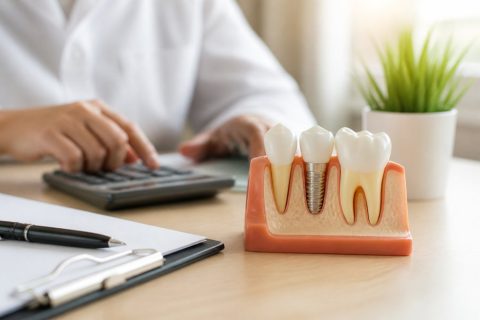
Dental Implant Cost and Insurance Coverage: 2026 Guide
Table of Contents
- What Dental Implants Actually Cost in 2026
- What’s Included in the Cost: Surgical vs. Restorative Phases
- Dental Implant Financing Options That Work
- Is Dental Implant Surgery Covered by Medical Insurance?
- Using HSA and FSA for Dental Implants
- How to Maximize Dental Insurance Coverage for Implants
- Conclusion
- Frequently Asked Questions
Last Updated: September 14, 2026
What Dental Implants Actually Cost in 2026
Dental implant cost in the United States is not a single number, and anyone who quotes you one upfront is guessing. The total depends on how many teeth you're replacing, whether you need bone grafting, and which parts of the procedure your dental benefits will actually pay for. At Midwest Center for Dentistry and Implants, we build a written treatment plan before we discuss a single figure.
A dental implant is a titanium post surgically placed into the jawbone to replace a missing tooth root, capped with an abutment and a crown. The cost is split across at least two phases, each with its own billing codes, coverage rules, and timeline.
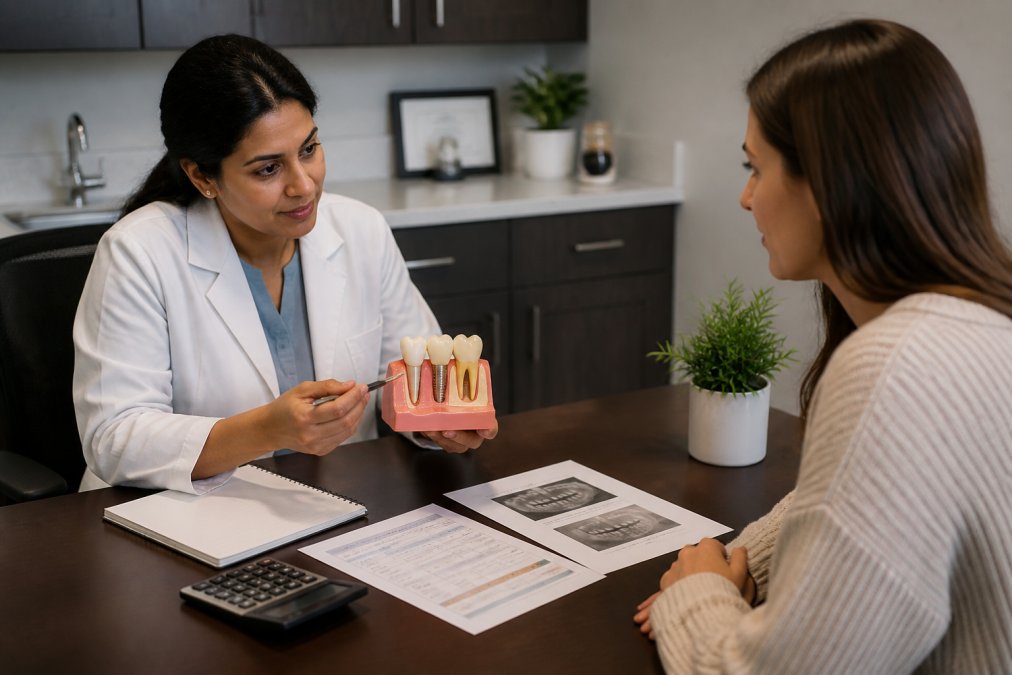
Single Tooth vs. Full-Arch Restoration
A single-tooth implant replaces one missing tooth with one implant, one abutment, and one crown. A full-arch restoration replaces an entire row, usually with four to six implants supporting a fixed prosthesis. Full-arch cases spread the surgical cost across more teeth but demand more planning, imaging, and often a temporary prosthesis while the implants integrate.
| Treatment Type | What It Replaces | Typical Phases | Main Cost Drivers |
|---|---|---|---|
| Single tooth | One missing tooth | Surgical placement + crown | Bone graft, abutment, crown material |
| Multiple teeth | Two to three adjacent teeth | Surgical + restorative | Number of implants, splinting |
| Full-arch restoration | Entire upper or lower row | Surgical + temporary + final prosthesis | Implant count, prosthesis material, sedation |
What’s Included in the Cost: Surgical vs. Restorative Phases
The surgical phase covers everything in the jaw: imaging, implant placement, any bone graft, and healing. The restorative phase covers the abutment and the crown or prosthesis on top. Insurance plans often treat these as separate procedures with separate coverage percentages, which is why a pre-determination matters before you schedule.
Think in billing codes. The surgical phase is billed under CDT D6000 series codes (implant services) plus D7000 series codes for grafting (the American Dental Association). The restorative phase uses D6000 codes for the abutment and D2000-D6000 codes for the crown or prosthesis. Because most plans assign different coverage percentages to surgical versus major restorative services, the same case can be reimbursed at two different rates depending on how the claim is split.
The Hidden Costs Nobody Warns You About
Most cost guides stop at the implant and the crown. The line items in between are why a quoted "base price" and a final invoice rarely match.
- Bone grafting (D6100-D6199): If the jaw has shrunk from missing teeth or gum disease, a graft is often required before placement. Ridge preservation at extraction is smaller and cheaper; a lateral or sinus graft is larger, with a healing window of several months. Grafting is frequently a separate surgical code with a different coverage percentage than the implant.
- Extraction (D7140 simple / D7210 surgical): The failing tooth usually comes out first, billed separately. Simple and surgical extractions are different codes with different fees, and a tooth that fractures during removal can move the case from one code to the other.
- CBCT imaging (D0367 and related codes): Three-dimensional scans are standard for implant planning because they show bone height, width, and nerve position. They are not always covered, and a flat implant fee may or may not include the scan. Ask.
- Temporary prosthesis (D5810-D5820 range): Full-arch patients need something to wear while implants integrate. A removable appliance and a fixed provisional carry very different fees.
- Sedation (D9222/D9223): It carries its own fee and coverage rules. Many plans exclude sedation entirely or cap it at a flat dollar amount.
- Abutment (D6056/D6057): The connector between implant and crown is sometimes bundled, sometimes billed separately. A custom abutment costs more than a stock one.
- Repairs and maintenance: Implants need the same cleanings and check-ups as natural teeth, plus periodic radiographs to confirm surrounding bone is stable. These are ongoing costs.
Why the Quoted Price and the Final Invoice Diverge
Advertised prices typically cover the implant fixture and crown only. Graft, extraction, scan, temporary, sedation, and custom abutment get added as the plan develops. Ask for a written plan listing every anticipated code, marking which are conditional ("only if the CBCT shows insufficient bone"), and stating the practice's fee for each. That document also goes with your pre-determination request.
Questions to Ask Before You Sign a Treatment Plan
- Which of these codes are included in the quoted fee, and which are billed separately?
- Is the graft conditional, and what is the fee if it is needed?
- Is the CBCT scan included, or billed to me or my plan?
- If the implant fails to integrate, what is the practice’s policy on the replacement fixture and the second surgery?
- What is the fee for the temporary, and how long will I wear it?
- Are there any codes you expect to add after the surgical phase begins?
Getting those answers in writing turns a range into a number you can plan around.
Dental Implant Financing Options That Work
Dental implant financing options fall into four buckets: in-house payment plans, third-party healthcare lenders, credit cards, and health savings accounts. The right pick depends on your credit, timeline, and whether your employer offers an HSA.
- In-house plans: Many practices split treatment into monthly installments with no interest over a short term. Ask what happens if a phase needs to be rescheduled.
- Third-party healthcare lenders: These companies specialize in medical and dental procedures and offer longer terms. Read the APR, not just the monthly payment.
- Credit cards: Convenient, but standard cards carry high APRs. A dedicated medical card may offer a promotional rate.
- HSA and FSA accounts: Pre-tax dollars, which effectively discounts the procedure.
For most patients, term length matters more than the rate. A longer term with a slightly higher APR can cost less per month than a short term with a lower one, and cash flow usually decides whether treatment happens.
Is Dental Implant Surgery Covered by Medical Insurance?
Dental implant surgery is rarely covered by medical insurance on its own, but there are specific situations where it is. Medical plans sometimes pay when the implant is medically necessary rather than purely cosmetic. The key distinction is clinical necessity: medical insurers ask whether the procedure restores function lost to disease or injury, not whether it improves your smile. Check this crossover before accepting a dental-only denial.
When Medical Insurance May Step In
Medical coverage may apply when the implant is tied to a medical event or condition rather than routine tooth loss. Situations where patients have successfully pursued medical benefits include:
- Traumatic injury: A tooth lost to an accident, sports injury, or assault, where the treating physician or emergency department documented the injury at the time.
- Reconstructive surgery after tumor or cyst removal: When the jaw or surrounding tissue is resected and the implant is part of rebuilding function.
- Congenital conditions: Missing teeth due to a diagnosed congenital condition, where the implant is part of a broader treatment plan managed by a physician or specialist.
- Medically necessary extractions and reconstruction: Cases where the underlying disease process, not the tooth itself, drives the need for the implant.
The unifying thread is documentation. A dental plan sees a missing tooth; a medical plan needs a medical cause. Without an ER note, physician letter, or imaging tied to the event, the medical claim is much harder to win.
How the Two Plans Interact
Dental and medical plans do not coordinate the way two medical plans do. Usually the dental plan is billed first for the implant codes, and if it denies or pays partially, the balance can go to the medical plan with clinical documentation attached. Some medical plans pay as primary when the procedure is clearly medical, but many want the dental plan's explanation of benefits first. Expect to move the paperwork yourself.
What to Submit With a Medical Claim
A medical claim for an implant is a documentation exercise. A typical submission includes:
- A letter of medical necessity from the treating dentist or physician that states the diagnosis, the functional loss, and why an implant is the appropriate restoration.
- The operative report or ER record from the event that caused the tooth loss, if one exists.
- Imaging that shows the current state of the bone and the missing tooth.
- The procedure codes and the dental plan’s denial or partial-payment explanation of benefits.
- Any relevant history showing the condition is not purely cosmetic.
Medicare and the Crossover
Original Medicare generally does not cover routine dental care, including implants, and there is no standalone Medicare dental benefit. Medicare Advantage plans may include dental coverage as a supplemental benefit, but scope varies widely and is often limited to preventive and basic services. For patients relying on Medicare, the practical path is usually a separate dental plan, a discount program, or a Medicare Advantage plan that explicitly lists implant coverage in its summary of benefits. Read the summary of benefits, not the marketing brochure.
Medicare dental coverage overview
If the Medical Claim Is Denied
A denial is not the end. Medical appeals follow the plan's internal procedure, and the appeal window is stated in the denial letter. The strongest appeals answer the specific denial reason, if the plan says the procedure is "dental in nature," explain why the diagnosis and functional loss make it medical. A second-level appeal or external review may be available if the internal appeal fails. Keep copies of everything and note the dates.
Using HSA and FSA for Dental Implants
HSA and FSA funds can pay for dental implants because the IRS treats implants as qualified medical expenses when used to alleviate or prevent a dental condition. That money comes out of pre-tax income, lowering your effective cost without touching your dental plan's annual maximum.
Two practical points. First, your FSA is use-it-or-lose-it within the plan year unless your employer offers a grace period or carryover, so timing a multi-phase implant around your plan year can preserve funds. Second, your HSA balance rolls over indefinitely, making it the better vehicle for a procedure a year or two out. Confirm specifics with your plan administrator, because contribution limits and eligibility rules change.
IRS Publication 502, Medical and Dental Expenses
How to Maximize Dental Insurance Coverage for Implants
Maximizing dental benefits for implants comes down to three moves: timing your phases around your plan year, getting a pre-determination in writing, and understanding your annual maximum before you schedule. Most plans cap total annual benefits, and a single implant can consume a large share. Splitting the surgical and restorative phases across two plan years is a common, legitimate way to use two years of benefits on one case.
Watch waiting periods too. Plans that cover implants often impose a waiting period on major services for new enrollees, and pre-existing conditions can affect coverage. If you're switching plans, ask about the major-services waiting period before you enroll.
Pre-Authorization and Appeals: Getting a Yes
Pre-authorization, sometimes called pre-determination, asks your insurer to confirm in advance what it will pay for a proposed treatment plan. Submit it with the clinical notes, imaging, and procedure codes your dentist provides. If denied, you have the right to appeal, and appeals succeed more often with a letter of clinical necessity from your treating dentist explaining why the implant is the appropriate restoration rather than a cheaper alternative.
Conclusion
The gap between what an implant costs and what your benefits cover is where most patients get stuck, and planning closes it. Midwest Center for Dentistry and Implants offers regenerative therapies like platelet-rich fibrin to support healing, and treats most services under one roof. If anxiety has kept you away from care, our team is trained to work with patients who need a slower, more comfortable pace.
Call us at (630) 766-0115 to schedule a consultation with Dr. Patel and get a written plan before you commit to anything.
Frequently Asked Questions
Will dental implants ever be covered by insurance?
Coverage depends on your plan and the reason for treatment. Most dental plans treat implants as a covered benefit when they restore function after tooth loss, but they often apply annual maximums, deductibles, and coverage percentages. Some plans exclude implants entirely as a cosmetic procedure. If an implant is needed after an accident or to treat a medical condition, medical insurance may cover part of the surgical placement. Always request a pre-determination so you know your out-of-pocket expenses before treatment begins.
Does standard dental insurance typically cover dental implants?
Many standard dental plans cover a portion of implant treatment, often 50 percent after you meet your deductible, up to your annual maximum. Coverage usually applies to the crown and sometimes the abutment, while the surgical placement may be treated differently. Some plans have waiting periods for major services or exclude implants for pre-existing conditions. Review your plan's coverage percentage, annual maximum, and any cosmetic exclusion before scheduling treatment.
What factors influence the total cost of dental implant surgery?
The total cost depends on several clinical and logistical factors: the number of implants needed, whether a bone graft or sinus lift is required, the type of restoration (single crown vs. full-arch), the materials used, and the provider's training and location. Additional imaging, sedation, and follow-up visits can add to the overall treatment plan. Because every case is different, your dentist should provide a written estimate that separates the surgical phase from the restorative phase.
How can I maximize my dental insurance benefits for implant procedures?
Start by requesting a pre-determination from your insurer before treatment. Schedule implant surgery early in the year if you have an annual maximum that resets, and consider splitting the surgical and restorative phases across two benefit years to use two maximums. Ask your dentist to submit accurate billing codes and provide clinical documentation of dental necessity. If a claim is denied, you have the right to appeal with supporting records from your dentist.
What financing options are available if insurance does not cover implants?
If insurance falls short, dental implant financing options include third-party healthcare credit cards, in-office payment plans, and personal loans from banks or credit unions. Some practices offer extended payment schedules with no interest for a promotional period. You can also use funds from a health savings account or flexible spending account if your plan allows dental expenses. Compare the total cost of each option, including any fees, before choosing.
Can I use my HSA or FSA to pay for dental implants?
Yes, dental implants generally qualify as eligible medical expenses for both health savings accounts and flexible spending accounts. You can use these pre-tax funds to cover the surgical placement, abutment, crown, and other qualified costs. Keep all receipts and explanation of benefits forms in case of an audit. Check your specific plan documents because some accounts have annual contribution limits or require a letter of medical necessity.
Are dental implants considered medically necessary or cosmetic?
Implants are often considered medically necessary when they restore chewing function, prevent bone loss, or replace teeth lost due to injury or disease. However, some insurers classify them as cosmetic if they are used purely for aesthetic reasons. The distinction matters because medical insurance may cover implants deemed medically necessary, while dental insurance may apply cosmetic exclusions. Your dentist can document clinical necessity to support your claim.
What is the downside of dental implants?
Dental implants require a surgical procedure, which carries risks such as infection, nerve damage, or implant failure. The healing process can take several months, and the total cost is often higher than bridges or dentures. Some patients need additional procedures like bone grafting before implants can be placed. Maintenance requires good oral hygiene and regular dental visits. Discuss your health history and expectations with a qualified dentist to determine if implants are right for you.