Non Invasive Snoring Treatment Options 2026
Table of Contents
- What Counts as Non Invasive Snoring Treatment in 2026
- QuietNite Protocol for Snoring: What It Is and How It Works
- Laser Snoring Treatment Effectiveness: What the Evidence Shows
- Custom Oral Appliance Therapy: A Non-Surgical Option for Airway Support
- Nasal Devices and Positional Therapy: Low-Cost Non Invasive Options
- Home Monitoring, Cost, and Safety: What to Know Before You Choose
- Frequently Asked Questions
Last Updated: September 15, 2026
What Counts as Non Invasive Snoring Treatment in 2026
Non invasive snoring treatment is any approach that reduces snoring without surgery, general anesthesia, or a hospital stay. It includes nasal devices, oral appliances, positional therapy, and office-based laser procedures.
At Midwest Center for Dentistry and Implants, we see patients every week who want snoring relief without surgery. The field has shifted toward office-based options that require little or no downtime.
Below, we break down every major non invasive snoring treatment option available in 2026, how long recovery takes, and who each option actually suits.
The options fall into three broad groups:
- Airway devices: nasal strips, internal dilators, and expiratory resistance valves
- Oral appliances: custom mouthpieces that reposition the jaw or tongue
- Tissue procedures: laser and radiofrequency treatments that tighten the soft palate
How Non-Surgical Options Compare to CPAP
CPAP remains the clinical standard for diagnosed obstructive sleep apnea. It delivers pressurized air through a mask to keep the airway open, and it is highly effective when worn consistently.
The problem is adherence. Many patients find masks bulky, noisy, or uncomfortable, and stop using them.
Non-surgical snoring treatments do not replace CPAP for moderate to severe sleep apnea. They work best for primary snoring, mild airway collapse, or as an addition to CPAP therapy for patients who cannot tolerate a full mask. If you have diagnosed sleep apnea, talk to your physician before switching devices.
| Option | Best For | Worn During Sleep | Addresses Apnea |
|---|---|---|---|
| CPAP | Diagnosed sleep apnea | Yes, nightly | Yes |
| Oral appliance | Mild apnea, jaw position | Yes, nightly | Sometimes |
| Nasal device | Congestion-based snoring | Yes, nightly | No |
| Laser procedure | Soft palate snoring | No | No |
QuietNite Protocol for Snoring: What It Is and How It Works
The QuietNite protocol is a non-invasive laser snoring treatment performed in a dental office using a DEKA CO2 laser. It targets the soft palate tissue to reduce the vibration that causes snoring.

Here is how a typical course works:
- Clinical consultation. We examine the airway, review your snoring history, and confirm you are a candidate.
- Treatment sessions. The laser delivers controlled light energy to the soft palate. Most protocols use a series of short appointments rather than one long session.
- Tissue response. The treated tissue stiffens over the following weeks, which reduces the flutter that produces snoring.
- Follow-up. We reassess snoring severity and sleep quality after the series is complete.
What most guides miss is that candidacy matters more than the device. A laser will not help snoring driven by nasal obstruction or tongue-base collapse. A proper airway exam comes first.
Laser Snoring Treatment Effectiveness: What the Evidence Shows
Laser snoring treatment effectiveness depends less on the laser than on whether the laser is aimed at the right tissue. The energy works by heating the soft palate and the tissue around the uvula, which causes collagen fibers to contract and the mucosa to stiffen over the following weeks. A stiffer palate flutters less, and less flutter means less snoring. If your snoring comes from the nose, the tongue base, or a narrow pharynx behind the palate, stiffening the palate will not fix it, which is why a candidacy exam matters more than the brand of laser.
A few things to weigh before booking:
- Results are gradual. Collagen remodeling takes weeks, not days. Most patients judge results at the 30- to 90-day mark, not the day after a session.
- Repeat sessions are common. Maintenance is usually a single touch-up session rather than a full repeat series.
- It is not permanent. Aging, weight gain, and hormonal changes can bring snoring back, and a maintenance session may be needed every 12 to 24 months.
- It does not replace a sleep study. If apnea is suspected, get tested first. A cosmetic fix for snoring can mask a serious airway problem.
The Two Protocols You Will See Named
NightLase is the most widely marketed laser protocol. It uses an erbium-doped laser (often a Fotona or similar platform) to deliver controlled pulses to the soft palate and the tissue around the uvula. A typical course is three sessions spaced about three to four weeks apart, with no anesthesia and no downtime. Patients usually return to normal eating and speaking the same day.
QuietNite is a CO2-laser protocol performed in a dental office. It also targets the soft palate, but the CO2 wavelength is absorbed more superficially, so the operator works in short passes rather than deep pulses. Protocols vary by provider, but a series of short appointments is standard rather than one long session.
Both approaches share the same limitation: they treat palatal snoring, not airway collapse.
Who Actually Responds
The patients who respond best tend to share a profile:
- Snoring that is loudest on inhalation and clearly palatal in origin
- A low BMI and no significant neck circumference
- No diagnosed obstructive sleep apnea, or only mild apnea
- A soft palate that visibly vibrates on exam
Patients who respond poorly often have nasal obstruction, a large tongue base, a retrognathic jaw, or significant apnea. For those patients, an oral appliance, nasal surgery, or CPAP is a better first move.
Who Should Avoid Laser Treatment
This is the part most guides skip. Laser snoring treatment is generally not appropriate if you:
- Have untreated moderate to severe obstructive sleep apnea
- Are pregnant or breastfeeding
- Have an active infection, cold sore, or open lesion in the mouth
- Have a bleeding disorder or take blood thinners that your physician has not cleared
- Have a pacemaker or other implanted electronic device, depending on the laser platform
- Have a history of keloid scarring or poor wound healing
- Cannot commit to the full session series and follow-up
Side effects are usually mild and short-lived: a sore throat, a sensation of swelling, or a dry mouth for a few days. Serious complications are uncommon but include mucosal burns, prolonged pain, and, rarely, a temporary change in voice or swallowing. Ask your provider what platform they use, how many sessions they recommend, and what their revision rate looks like.
American Academy of Sleep Medicine guidance on snoring and sleep apnea
Custom Oral Appliance Therapy: A Non-Surgical Option for Airway Support
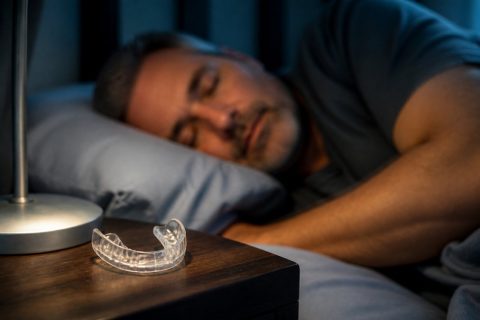
Custom oral appliance therapy uses a dentist-made mouthpiece to hold the lower jaw or tongue forward during sleep. Moving the jaw forward opens the airway and reduces the collapse that causes snoring.
Unlike drugstore boil-and-bite guards, a custom appliance is fitted to your bite and adjusted over time. That fit is the difference between a device you wear every night and one that sits in a drawer.
Two main types exist:
- Mandibular advancement devices (MADs): hold the jaw forward
- Tongue-retaining devices (TRDs): hold the tongue forward with suction
Custom appliances are also one of the few non-surgical options that can be integrated with CPAP therapy.
Nasal Devices and Positional Therapy: Low-Cost Non Invasive Options
Home Monitoring, Cost, and Safety: What to Know Before You Choose
The Cost Picture Over Five Years
| Option | Upfront Cost | Recurring Cost | 5-Year Estimate |
|---|---|---|---|
| Nasal strips | Low (about $15 per box) | Replaced nightly or weekly | Highest of the low-cost options |
| Internal nasal dilators | About $20, reusable | Replacement every few months | Low |
| Magnetic dilators | About $29 plus adhesive tabs | Adhesive tabs replaced regularly | Moderate |
| Custom oral appliance | Higher upfront, dentist-fitted | Adjustments, replacement every 3-5 years | Moderate to high |
| Laser procedure | Per-session fee, commonly starting around $500 | Possible maintenance session every 12-24 months | Moderate, front-loaded |
| CPAP | Equipment cost | Masks, filters, tubing, humidifier parts replaced on a schedule | High, ongoing |
Safety Profiles and Who Should Avoid What
How Non-Invasive Options Fit With CPAP
Frequently Asked Questions
What is the newest non-invasive treatment for snoring in 2026?
Laser-assisted therapies such as the DEKA CO2 laser with the QuietNite protocol are among the newest office-based options. These treatments use light energy to tighten soft palate tissue without surgery or general anesthesia. Other recent developments include magnetic nasal dilators and expiratory positive airway pressure valves. Each option targets a different part of the airway, so a clinical consultation helps determine which approach fits your snoring pattern.
Are oral appliances considered non-invasive snoring treatments?
Yes. Custom oral appliance therapy is non-invasive because it involves no surgery or medication. A dentist fits a device that repositions the lower jaw or tongue to keep the airway open during sleep. These appliances are particularly helpful for mild to moderate obstructive sleep apnea and snoring caused by jaw position. They require professional fitting and periodic adjustments to remain effective and comfortable.
How does laser-assisted snoring treatment work?
Laser-assisted snoring treatment delivers controlled light energy to the soft palate and surrounding tissue. This causes collagen contraction and tissue stiffening, which reduces the vibration that creates snoring. Most protocols involve three to four sessions with no downtime. Results vary by patient, and your provider will assess whether your snoring originates from the soft palate before recommending this option.
What should I look for when choosing a snoring treatment provider?
Look for a provider who evaluates the root cause of your snoring rather than offering a single device. Ask whether they screen for obstructive sleep apnea, offer multiple treatment types, and track outcomes. A dentist trained in sleep dentistry can fit oral appliances and perform laser procedures. Bring questions about candidacy, expected results, and follow-up care to your first visit.