
How to Handle Dental Appointment Jitters: 7 Calming Steps
Table of Contents
- Why Dental Appointment Jitters Happen (and Why You’re Not Alone)
- How to Talk to Your Dentist About Anxiety Before Treatment Starts
- Breathing Exercises for Dental Appointments You Can Do in the Chair
- Choosing a Dentist for Nervous Patients: What to Look For
- Distraction Techniques and Fidget Tools That Actually Help
- Sedation Dentistry Options for Severe Dental Phobia
- Managing Post-Appointment Anxiety and Financial Worries
- Conclusion
- Frequently Asked Questions
Last Updated: September 11, 2026
Why Dental Appointment Jitters Happen (and Why You’re Not Alone)
Dental appointment jitters are the mix of nervousness, tension, and racing thoughts that surface before or during a dental visit. At Midwest Center for Dentistry and Implants, we understand that many patients have avoided care for years because of this exact feeling. You are not weak or unusual for feeling it.
The roots usually run deeper than the drill. Many people trace their dental appointment jitters back to a painful childhood procedure, a fear of losing control while reclined in the chair, or embarrassment about the condition of their teeth. Others carry dental phobia passed down from a parent who dreaded the dentist. Identifying your specific trigger is the first real step toward managing it.
How to Talk to Your Dentist About Anxiety Before Treatment Starts
Tell your dental team about your anxiety before the appointment, not during it. A phone call or a note at scheduling gives the practice time to adjust the visit, from a longer appointment slot to a quieter room.
When you arrive, be specific. "I get anxious" is a start, but "I need you to explain each step before you do it" gives the team something to act on. Mention past bad experiences, what triggers a panic attack, and whether you want numbing before anything else begins.
Using a Stop Signal to Stay in Control
A stop signal is a pre-agreed hand gesture, such as a raised hand, that pauses treatment the moment you use it. Agree on it with your dentist before work starts. This single protocol restores a sense of control, which is what most anxious patients actually crave. The American Dental Association's guidance on patient communication supports clear, ongoing dialogue between patient and provider.
Breathing Exercises for Dental Appointments You Can Do in the Chair
Slow, controlled breathing is the fastest tool you can use once you are seated. Try this: inhale through your nose for a count of four, hold for four, then exhale through your mouth for six. The longer exhale signals your nervous system to settle (the NIH).
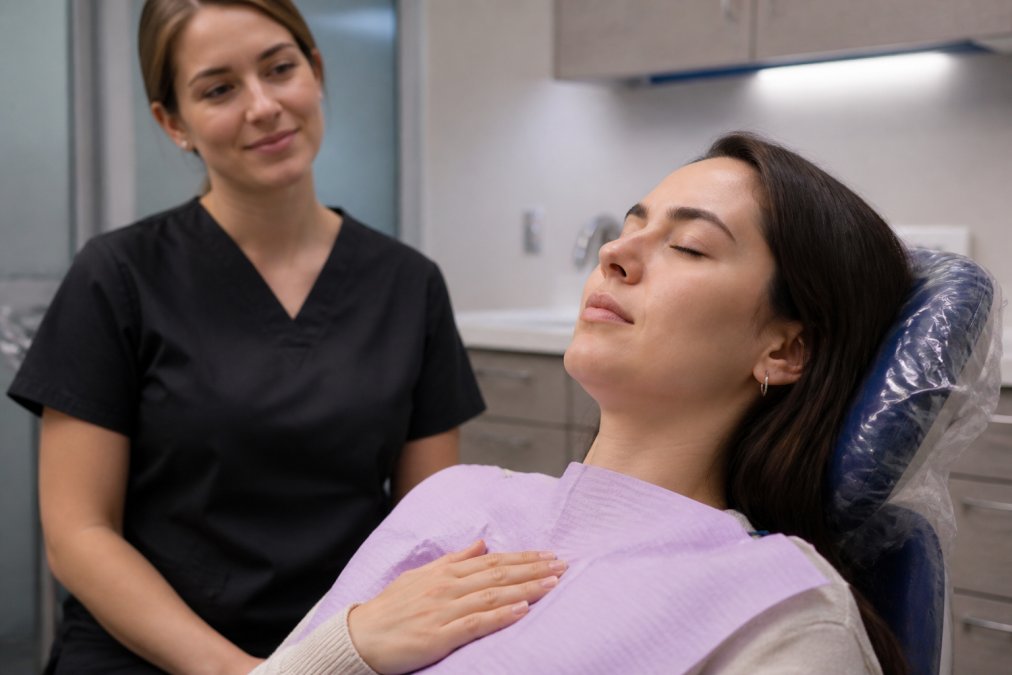
Guided imagery pairs well with breathing: picture a familiar, safe place in detail, from the sounds to the temperature. A mindfulness app like Calm offers structured breathing programs you can run in the waiting room, and many people find the audio gives their mind something to hold onto.
Progressive Muscle Relaxation and Guided Imagery
Progressive muscle relaxation means tensing one muscle group for a few seconds, then releasing it, working from your toes to your jaw. In the chair, focus on your hands and shoulders, the areas that tighten first. Combined with guided imagery, this technique interrupts the physical stress response before it snowballs.
Choosing a Dentist for Nervous Patients: What to Look For
Not every practice is set up for anxious patients, and the difference is usually visible before you sit in a chair. Treat the first phone call as a screening, not a scheduling formality. You are allowed to interview the office.
Questions Worth Asking Before You Book
- “Do you offer sedation, and who administers it?” Nitrous oxide is commonly offered in general practices; oral conscious sedation and IV sedation require additional training and specific permits. Ask who provides it and what monitoring is in place.
- “Can I tour the office or do a meet-and-greet visit first?” Some practices offer a short no-treatment visit so you can see the room, meet the hygienist, and sit in the chair without anyone reaching for an instrument.
- “How do you handle a patient who needs to pause?” A good answer describes a specific protocol, not a vague reassurance.
- “Will you walk me through each step before you do it?” This is a reasonable request and a useful test of how the team communicates.
- “What is your policy if I need to reschedule?” Knowing the cancellation window in advance removes one more source of dread.
Sensory-Friendly Practices: A Gap Most Guides Skip
If you are neurodivergent, or simply sensitive to sound, light, and smell, a standard operatory can be overwhelming for reasons that have nothing to do with pain. The drill, the overhead light, the latex gloves, the mint polish, the ultrasonic scaler, each is a separate input, and they stack.
Ask specifically about:
- Lighting. Can the overhead light be dimmed or angled away from your eyes? Some patients do better with sunglasses or a light-blocking eye mask.
- Sound. Are noise-canceling headphones welcome? Is there a quieter room or a less busy time of day?
- Smells and textures. Can the practice use an unflavored polish or a non-latex glove? Is there a scent-free option?
- Pacing. Can the hygienist break a cleaning into two shorter visits rather than one long one?
These are reasonable accommodations, and practices that serve anxious patients tend to have answers ready. If the person on the phone sounds annoyed by the questions, that is useful information.
What a Nervous-Patient-Friendly Practice Actually Looks Like
Beyond the checklist, look for signals in how the office operates:
- They ask about anxiety at intake, not only when you bring it up.
- They offer a stop signal without being prompted, or agree to one immediately.
- They quote costs before treatment, not after.
- They do not upsell during a visit when you are already stressed. A written plan you can take home and review is a better sign than a same-day pressure to commit.
- They schedule realistically. A practice that books 20-minute slots for anxious patients will rush you; one that builds in extra time is telling you something.
At Midwest Center for Dentistry and Implants, our team is trained on advanced procedures and modern technology, and we focus on customized care and treat each patient as an individual. A practice that rushes you through the door will not solve the problem, and you are allowed to keep looking until you find one that does not.
Distraction Techniques and Fidget Tools That Actually Help
Distraction works because your brain cannot fully process two demanding inputs at once. Noise-canceling headphones block the high-pitched whine of the drill and let you play music or a podcast. A squeeze ball or fidget spinner gives nervous energy somewhere to go.
- Squeeze balls: cheap, silent, and effective for hand tension
- Fidget spinners: good for waiting-room restlessness
- Headphones: best for patients sensitive to clinical sounds
- Weighted blankets: helpful for patients who tense up physically
Sedation Dentistry Options for Severe Dental Phobia
Sedation dentistry offers pharmacological support when breathing and distraction are not enough. Options range from nitrous oxide, which wears off within minutes, to oral conscious sedation taken before your visit, to deeper intravenous sedation for complex procedures.
These are pharmacological interventions, and they require a conversation with your dentist about your health history and medications. For patients with genuine dental phobia, sedation can be the difference between years of avoidance and getting needed care. Ask what your practice offers and who administers it.
Managing Post-Appointment Anxiety and Financial Worries
Most guides stop when you stand up from the chair. In practice, the hours after a visit are when a lot of patients feel the crash: shaky hands, a clenched jaw, irritability, or a wave of exhaustion that seems out of proportion to what actually happened. That reaction is a normal adrenaline letdown, not a sign that something went wrong. Planning for it is part of managing dental appointment jitters, not an afterthought.
A few concrete moves help:
- Block a buffer. Do not schedule a high-stakes meeting, a difficult conversation, or a long drive immediately after a procedure. Give yourself 30 to 60 minutes of low-demand time.
- Eat and hydrate. Skipping breakfast before an appointment (a common move when you are nervous) plus a numbing agent can leave you lightheaded afterward. Keep a snack and water in the car.
- Write down what happened. Jotting two or three lines about what went better than expected builds a factual record your brain can use before the next visit. Anxiety thrives on vague memory; specifics shrink it.
- Debrief with the office if needed. If a step caught you off guard, a short call or portal message the next day is reasonable. Most teams would rather adjust than lose you to avoidance again.
When Cost Is the Real Trigger
Financial anxiety is one of the most under-discussed root causes of dental avoidance. Patients often describe it as fear of the drill, when what they actually fear is an unknown bill arriving weeks later. Separating those two fears matters, because they have different fixes.
Ask for these specifics before treatment begins:
- A written treatment plan that lists each procedure, the order it should happen in, and what is urgent versus what can wait.
- A clear split between what your dental insurance is expected to cover, what your plan’s annual maximum is, and what your estimated out-of-pocket portion will be. Ask whether the estimate assumes the plan pays or denies.
- Whether the practice offers in-house payment plans, third-party financing, or a discount for paying in full. Terms vary widely, so ask rather than assume.
- Whether phasing treatment over multiple visits or multiple calendar years changes the cost, especially if you are near an annual maximum.
The Pediatric-to-Adult Transition
A pattern that gets almost no coverage: many adults are not afraid of the dentist in general, they are afraid of the dentist they had as a child. If your last regular visits were in a pediatric office with cartoons, prizes, and a parent in the room, walking into an adult practice can feel like losing a safety net you did not know you were relying on.
You can rebuild that scaffolding deliberately. Ask whether a support person can sit in the room. Ask for the same kind of step-by-step narration a good pediatric hygienist provides. If you liked having a parent or partner nearby, say so, many adult practices allow it and simply do not offer because most patients never ask. Naming the transition out loud also helps: telling the team "my last dentist was a pediatric office and I am still adjusting" gives them a clear frame for how to pace the visit.
Conclusion
Dental appointment jitters are manageable, but only if you address the cause rather than white-knuckling through each visit. Start with one honest conversation with your dental team, then build your coping tools from there.
At Midwest Center for Dentistry and Implants, Dr. Patel and our team offer personalized care, a comfortable and relaxing environment, and comprehensive treatment planning. Call us at (630) 766-0115 to schedule a visit built around your comfort.
Frequently Asked Questions
How to calm down anxiety before a dental appointment?
Start with 4-7-8 breathing: inhale for 4 counts, hold for 7, exhale for 8. Do this in the waiting room or car. Pack noise-canceling headphones and a fidget tool. Write down your fears and share them with your dentist before treatment begins. Avoid caffeine on appointment day, since it can amplify pre-appointment anxiety and make your heart race. Arrive 10 minutes early so you are not rushed.
Can dentists tell if you have anxiety?
Yes. Dentists notice signs like clenched fists, rapid breathing, sweating, or gripping the dental chair arms. Tell your dentist directly so they can adjust their approach. A good practice will slow down, explain each step, and offer breaks. Using a stop signal gives you control and helps the dental team respond before jitters escalate into a panic attack.
What are the signs of dental phobia versus normal appointment jitters?
Appointment jitters include nervousness, sweaty palms, and mild worry before a dental procedure. Dental phobia is more intense: panic attacks, trouble sleeping for days before a visit, or avoiding the dentist for years despite pain. If anxiety keeps you from routine dental hygiene visits, tell a provider. Sedation dentistry, including nitrous oxide or oral conscious sedation, can help you get care.
How do I find a dentist who works with nervous patients?
Ask directly whether the practice offers comfort options like topical numbing gel, noise-canceling headphones, or sedation dentistry. Read reviews for mentions of patient comfort and patient-dentist communication. A dentist for nervous patients will welcome a pre-visit phone call, explain the treatment plan without pressure, and never make you feel judged about your dental hygiene or gaps in care.