Implants & Full-Arch · 4-min read
What is PRF, and how do we use it in dental surgery?
 Clinically reviewed by Shivam S. Patel, DDS, AFAAID · Last reviewed October 18, 2026
The short answer
Platelet-rich fibrin (PRF) is a small clot made from your own blood. We draw a few tubes in our office, spin them in a centrifuge, and place the fibrin that forms into the surgical site. Dr. Patel uses it in some extractions, bone grafts, and implant sites. Whether it fits your case is decided at your consultation.
What PRF is
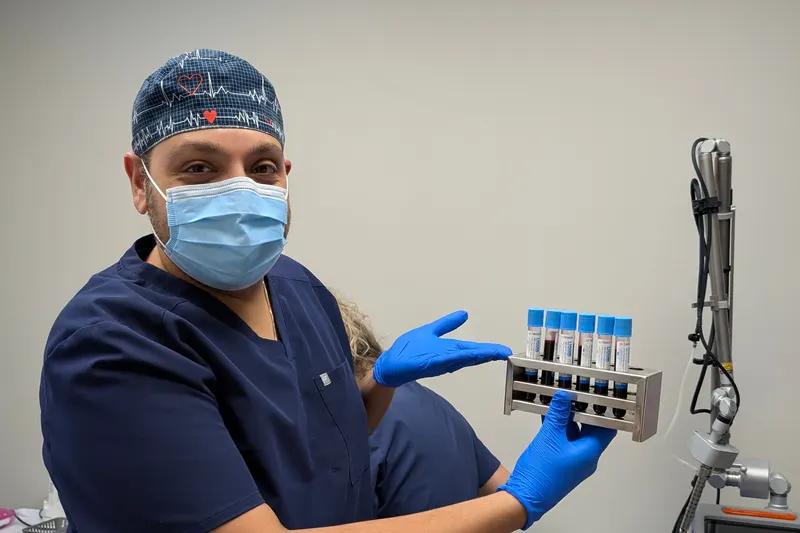
PRF stands for platelet-rich fibrin. It starts as a small sample of your own blood, drawn the same way as a routine lab test. The tubes go into a centrifuge, which spins the blood so that its parts separate. Because nothing is added to the tube, the blood clots naturally during the spin, and a yellowish fibrin clot forms. That clot, which holds platelets and white blood cells from your own blood, is the PRF.
It can be used as a soft clot, pressed into a thin membrane, or mixed with bone-graft material, depending on what the site needs.
Where we use it
At MCDI, Dr. Patel uses PRF in three kinds of surgical sites: tooth extractions, bone grafts, and dental implant placement.
Not every case calls for it. Dr. Patel decides during planning, based on the site and the procedure, and tells you before surgery whether PRF is part of your plan.
What happens at your visit
Because PRF comes from your own blood, it’s prepared on the day of surgery. The draw is done in the treatment room by someone certified in phlebotomy; usually that’s Dr. Patel himself, and we’re training other members of our team as well. Depending on the case, it’s two to six small tubes of 10 ml each. For comparison, a blood donation takes about 450 ml. While you’re getting numb, the tubes spin in the centrifuge, and the fibrin is ready by the time Dr. Patel needs it. It’s placed in the site before the gum is closed.

Afterward, you follow the same instructions you’d follow for that procedure without PRF.
What PRF doesn’t do
PRF is a tool, not a guarantee. It doesn’t replace a bone graft where bone is missing, it doesn’t change whether an implant is a good idea for you, and it doesn’t take the place of the healing instructions we give you after surgery. There is extensive research on PRF in dentistry and it can often speed up healing or make healing more predictable.
Questions to ask at your consultation
- Is PRF part of my plan, and why or why not?
- Is there a separate fee for it? Some procedures include PRF in the fee and some don’t; your written plan says which.
- Is there anything about my health or medications that affects whether you’d use it?
This article is general education, not a diagnosis or treatment plan. Your own plan comes from an exam, and if anything here differs from the written instructions Dr. Patel gave you, follow those.
FAQ
Does the blood draw hurt?
It’s a standard draw from a vein in your arm, like a lab test, and it takes about a minute. Most patients find it the easiest part of the visit.
Is PRF the same as PRP?
No. Both come from your own blood, but platelet-rich plasma (PRP) is made with an added anticoagulant and stays liquid, while PRF is spun without additives and clots on its own into a fibrin matrix. Dr. Patel uses PRF.
Can anyone have PRF?
Because it’s made from your own blood, there’s nothing foreign in it. The most common reason we don’t use it is active cancer. Other health conditions and medications can matter too, so tell us about your full medical history at your consultation.